
World’s First Fully Robotic Transoral Gastric Procedures Completed Using EndoQuest’s Endoluminal Surgical System
First-in-human use of the ELS System in endobariatrics marks the platform’s entry into the upper GI tract and
Press Release Disclaimer: This is a press release distributed through the XPR Media network. It has not been independently verified by our newsroom.


EndoQuest Robotics, Inc., developer of flexible robotic technology for endoluminal procedures, today announced the successful completion of two robotic transoral gastric reconstruction procedures using the company’s Endoluminal Surgical (ELS) System. Building on the established clinical framework of transoral outlet reduction (TORe), this fully robotic approach uses two-handed instrumentation to precisely perform full-thickness suturing, bringing surgical dexterity and control to post-bypass gastric reconstruction entirely through the mouth. Together, these cases mark a dual milestone: the world’s first fully robotic transoral gastric procedures and the ELS System’s first clinical use in the upper gastrointestinal (GI) tract. The approach is also the first in a planned series of next-generation procedures EndoQuest is developing with the goal of improving the durability and precision of endoluminal procedures and, ultimately, patient outcomes.
This press release features multimedia. View the full release here: https://www.businesswire.com/news/home/20261105851496/en/
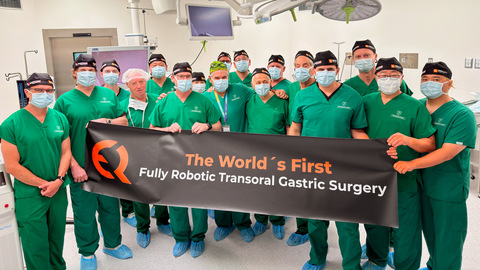
Eduardo Fonseca, CEO of EndoQuest Robotics, with the medical team responsible for the world’s first fully robotic transoral gastric surgery.
The landmark procedures were performed at The Panama Clinic in Panama City, Panama, led by Dr. Todd Wilson, with local principal investigator Dr. Richard Altieri Pérez. Dr. Wilson serves as EndoQuest Robotics’ Chief Medical Officer and Chairman of the International Advisory Board and is Professor of Surgery at McGovern Medical School at UTHealth Houston. Dr. Altieri is a general surgeon at The Panama Clinic who specializes in minimally invasive and robotic surgery, with a particular focus on bariatric and metabolic procedures.
“These cases demonstrate a fundamentally new robotic endoluminal gastric reconstruction,” said Dr. Wilson. “We can bring basic surgical technique directly to the target, without external incisions. This opens up vast opportunities to conduct direct, durable interventions that aren’t practical or even possible today. It was especially meaningful to be joined in Panama by Drs. Fred Moll and Santiago Horgan, whose pioneering work helped shape the fields of robotic and natural orifice surgery, and by Drs. Mohamed Othman and Michel Kahaleh, whose leadership is helping define the future of endoluminal surgery.”
Roux-en-Y gastric bypass (RYGB) is an effective treatment for obesity, but some patients subsequently develop dilation of the gastrojejunal anastomosis, which can contribute to recurrent weight gain or refractory dumping syndrome. Conventional TORe uses endoscopic suturing to reduce the outlet diameter and, when appropriate, reshape the gastric pouch, offering a less invasive alternative to surgical revision.
A five-year study found that TORe can provide sustained weight-loss benefits, although outcomes varied and nearly 40% of patients received additional weight-loss therapy during follow-up.1 Taken together, these findings demonstrate sustained benefit while also highlighting an opportunity to improve the consistency and long-term durability of endobariatric interventions.
“It is an honor for Panama and our clinical team to participate in this historic milestone,” said Dr. Altieri. “Conducting this first-in-human study here reflects Panama’s established strength in rigorous clinical research and its commitment to advancing surgical innovation. The future of bariatric care will increasingly be shaped by less invasive, technology-enabled procedures, and we are proud to help advance that future.”
Expanding robotic endoluminal surgery into endobariatrics
For suturing-based endobariatric procedures, the depth of tissue engagement can affect outcomes. In a matched-cohort study of TORe, full-thickness suturing was associated with greater weight loss than superficial suturing at 6 and 12 months.2 Achieving this depth consistently, however, can be technically challenging with conventional flexible endoscopy.
The ELS System is specifically designed to overcome key technical barriers in complex endoluminal procedures by enabling two-handed robotic instrument control, dynamic countertraction, and triangulation, all within a stable operating field. Together, these capabilities support precise tissue exposure and manipulation of deeper tissue layers, direct muscle-to-muscle apposition, and reliable full-thickness suturing.
“Having also been present for the first cases performed in EndoQuest’s lower GI PARADIGM Trial, what I witnessed in Panama represents a major expansion in the clinical reach of robotic surgery,” said Dr. Fred Moll, Chairman of the Board of EndoQuest Robotics and co-founder of Intuitive Surgical and Auris Health. “Designing a flexible system that can operate within the constraints of endoscopy while delivering the precision required for surgery is an extraordinary engineering challenge. The EndoQuest team has demonstrated the technical expertise required to develop an endoluminal platform capable of supporting a growing range of procedures across the GI tract, making this an exciting milestone not only for the company, but for healthcare more broadly.”
EndoQuest is also developing additional robotic endobariatric procedures. One example is robotic transluminal gastric plication, a true natural orifice transluminal endoscopic surgery (NOTES) approach in which seromuscular suturing is performed from outside the stomach without external incisions. In a preclinical study conducted at Brigham and Women’s Hospital (BWH), the technique achieved a mean gastric volume reduction of 70%.3
“When I began exploring natural orifice surgery in the early 2000s, the instruments available to us were rudimentary, which limited control and tissue handling capabilities required for complex procedures,” said Dr. Santiago Horgan, Professor Emeritus of Surgery at the University of California, San Diego School of Medicine. “The vision of performing surgery without external incisions was compelling, but the technology was not yet ready. Flexible robotics now offers a way to overcome those longstanding limitations, close the gap between endoscopy and surgery, and ultimately improve outcomes for patients.”
More broadly, the platform’s suturing capabilities have been evaluated in two prospective preclinical defect closure studies conducted at BWH.4,5 In one study, gastroenterologists without prior defect closure experience achieved 100% technical success using robotic closure, compared with 37.5% using conventional endoscopic suturing and 0% using helical tacking. Robotic closure also achieved maximum leak pressures more than five times those achieved with the conventional techniques.4 These results suggest that the ELS System could reduce technical barriers for physicians learning to perform endoluminal suturing.
Consistent with these findings, a separate randomized preclinical study at BWH comparing robotic and conventional endoscopic submucosal dissection (ESD) in gastroenterologists without prior ESD experience provided further evidence that the ELS System could improve novice performance and potentially shorten the learning curve for complex endoluminal procedures. In this study, robotic ESD achieved a 100% en bloc resection rate, compared with 40% for conventional ESD, while reducing mean procedure time from 85.1 minutes to 32.3 minutes and reducing perforations from 30% to 0%.6 Data from this preclinical ESD study supported the ELS System’s acceptance into the FDA’s Safer Technologies Program (STeP), which is designed to expedite the development, assessment, and review of devices reasonably expected to significantly improve the safety of currently available treatments. To EndoQuest’s knowledge, the ELS System is the only surgical robotic platform currently under active development to have been accepted into STeP.
Clinical, regulatory, and commercial momentum
The Panama milestone extends EndoQuest’s recent clinical momentum. In July 2026, the company completed enrollment in the PARADIGM Trial, a pivotal multicenter investigational device exemption (IDE) study evaluating the ELS System in transanal ESD. Preliminary results presented at the 2026 Society of Robotic Surgery (SRS) Annual Meeting included a 100% en bloc resection rate, 100% conversion-free rate, 95.8% R0 resection rate, and no device-related bleeding or perforations.
Building on this progress, EndoQuest is preparing a De Novo Classification Request and targeting a 2027 U.S. launch, subject to FDA marketing authorization. The commercial context is also evolving, with growing U.S. coding recognition for advanced endoluminal therapies relevant to the ELS System’s target portfolio, including a Category I CPT code for endoscopic sleeve gastroplasty (ESG) effective January 1, 2026; hospital outpatient HCPCS codes for TORe and endoscopic defect closure; and newly accepted CPT codes for upper and lower GI ESD expected to become effective January 1, 2027.
“These procedures expand the ELS System beyond the lower GI application evaluated in PARADIGM and mark the beginning of a new phase for EndoQuest,” said Eduardo Fonseca, Chief Executive Officer of EndoQuest Robotics. “They reflect years of clinical development that have enabled us to refine the platform to meet the unique technical demands of robotic endoluminal surgery. The accumulated clinical experience provides EndoQuest with a strong foundation for building a differentiated portfolio of upper GI and endobariatric procedures, substantially expanding the clinical and commercial value of the ELS System.”
References
- Jirapinyo P, Kumar N, AlSamman MA, Thompson CC. Five-year outcomes of transoral outlet reduction for the treatment of weight regain after Roux-en-Y gastric bypass. Gastrointestinal Endoscopy. 2020;91(5):1067-1073. doi:10.1016/j.gie.2019.11.044.
- Kumar N, Thompson CC. Comparison of a superficial suturing device with a full-thickness suturing device for transoral outlet reduction (with videos). Gastrointestinal Endoscopy. 2014;79(6):984-989. doi:10.1016/j.gie.2014.02.006.
- Wilson TD, Chandel V, Shin D, Pasam RT, Jirapinyo P, Thompson CC. Gastric volume reduction by robot-assisted endoscopic transluminal gastroplasty in an ex-vivo experimental porcine stomach model: a novel technique in endobariatrics. Gastroenterology. 2025;169(1 Suppl). doi:10.1016/S0016-5085(25)03856-9.
- Walradt T, Pasam RT, Szvarca D, Chandel V, Thompson CC. Full thickness colon defect closure with an endorobotic system versus current endoscopic suturing techniques in endoscopists without defect closure experience: a multiarm randomized study. Gastrointestinal Endoscopy. 2025;101(5 Suppl). doi:10.1016/j.gie.2025.03.833.
- Szvarca D, Chandel V, Walradt T, Pasam RT, Shin D, Wilson TD, Thompson CC. Robot-assisted versus conventional transluminal gastrointestinal defect closure: a comparative pre-clinical study. Gastrointestinal Endoscopy. 2025;101(5 Suppl). doi:10.1016/j.gie.2025.03.595.
- Szvarca D, Walradt T, Aihara H, Thompson CC. Robot versus conventional ESD for colonic lesions: results from a randomising model trial. Gut. Published online October 28, 2025. doi:10.1136/gutjnl-2025-336937.
About EndoQuest Robotics
EndoQuest Robotics is redefining what is possible in endoluminal procedures through flexible robotic technologies. The company’s platform is designed to bring true surgical capabilities to endoluminal intervention, enabling greater precision, dexterity, and control to simplify complex procedures and expand therapeutic possibilities in less invasive care. The EndoQuest Endoluminal Surgical System has been evaluated in nearly 100 clinical cases worldwide, including 50 colorectal endoscopic submucosal dissection procedures in the pivotal multicenter U.S. PARADIGM Trial. For more information, visit www.endoquestrobotics.com.
EndoQuest’s Endoluminal Surgical System is an investigational device, has not been cleared by the FDA, and is not yet available for commercial sale in the United States.
View source version on businesswire.com: https://www.businesswire.com/news/home/20261105851496/en/
Media gallery
